TThe Economy of 2035

Scribed by Mr. Derrick Macharia
November 27, 2025 • In the Sacred Halls

A Macro-Strategic Backcast of the Global Economy (2035–2025)
Strategic Audit and Calibration
Critical Review: 'The Great Demographic Divergence'
Rating: 7.5/10
Executive Critique and Theoretical Re-alignment
The widely held perspective "The Great Demographic Divergence" serves as a competent, albeit traditional, demographic survey of the mid-21st-century landscape. It correctly identifies the fundamental bifurcation of the global human capital stock: the rapid aging and contraction of the OECD and Chinese workforces contrasted against the burgeoning youth bulge of Sub-Saharan Africa and India. The reliance on OECD and UN Population Division data provides a statistically sound basis for these projections. The report accurately diagnoses the looming "old-age dependency ratio" crisis, noting that without significant policy intervention, the fiscal burden of pension and healthcare obligations will severely retard GDP per capita growth in advanced economies. Furthermore, the identification of Sub-Saharan Africa’s population surge—expected to rise by 79% over the next 30 years—as a potential reservoir of global labor is a standard, empirically supported demographic observation.
However, the report’s predictive power is substantially limited by its treatment of demographics as an isolated variable, operating in a ceteris paribus vacuum. It fails to integrate two disruptive exogenous shocks that are currently reshaping the production function of the global economy: the non-linear trajectory of Embodied Artificial Intelligence (humanoid robotics) and the binding constraints of the energy-materials nexus. By viewing economic output strictly as a function of human labor hours, the report underestimates the elasticity of labor substitution. It effectively predicts a 2035 economy using 2015 constraints.
The first critical oversight lies in the omission of the Automation Offset. The report presumes a linear relationship between workforce contraction and economic stagnation. It ignores the "Technological Dividend" derived from the deployment of general-purpose humanoid robots. With unit costs for humanoids projected to fall precipitously to between $17,000 and $30,000 by the early 2030s , the physical labor gap in G7 nations will be bridged not merely by migration, but by capital assets. The economic implications of replacing variable labor costs with fixed capital costs in sectors like logistics, manufacturing, and elder care are profound and absent from the provided analysis.
Secondly, the report characterizes the aging population primarily as a fiscal liability, neglecting the explosive consumption potential of the Silver Economy. This sector, already valued at $15 trillion globally, is projected to expand significantly, driven by the "New Mature Group" (aged 50-74) who possess the highest concentration of disposable wealth in history. The medical technology and automated service sectors catering to this cohort will likely be primary engines of GDP growth, transforming the "burden" of aging into a driver of specialized demand.8
Thirdly, the report is overly optimistic regarding the African Demographic Dividend. It assumes a 20th-century pathway to industrialization where excess labor naturally flows into low-skill manufacturing and business process outsourcing (BPO). This ignores the "Demographic Trap" posed by Generative AI, which is actively automating the entry-level white-collar and BPO roles that traditionally served as the first rung of the economic ladder for developing nations. The window for labor-intensive industrialization is closing, forcing a difficult pivot toward green industrialization and high-value data verification, a transition the report fails to explore.
Finally, the report lacks a Material Reality Check. It projects economic expansion without accounting for the physical inputs required to sustain it. The high-tech, AI-driven economy envisioned for 2035 is intensely resource-hungry, particularly for copper and lithium. With structural deficits in these critical minerals projected to hit by 2035 12, "Greenflation" and resource nationalism will likely act as binding constraints on growth, creating a geopolitical environment defined by scarcity rather than the abundance implied in the demographic dividend thesis.
Strategic Adjustments for This Projection
To remedy these gaps, the following analysis employs a Backcasting Methodology. We anchor our analysis in the realized state of the 2035 economy—a world where the demographic crisis has been neutralized by automation and defined by resource scarcity—and trace the causal chains backward to the present day (2025). This approach highlights the friction points, technological breakthroughs, and geopolitical realignments that will define the coming decade.
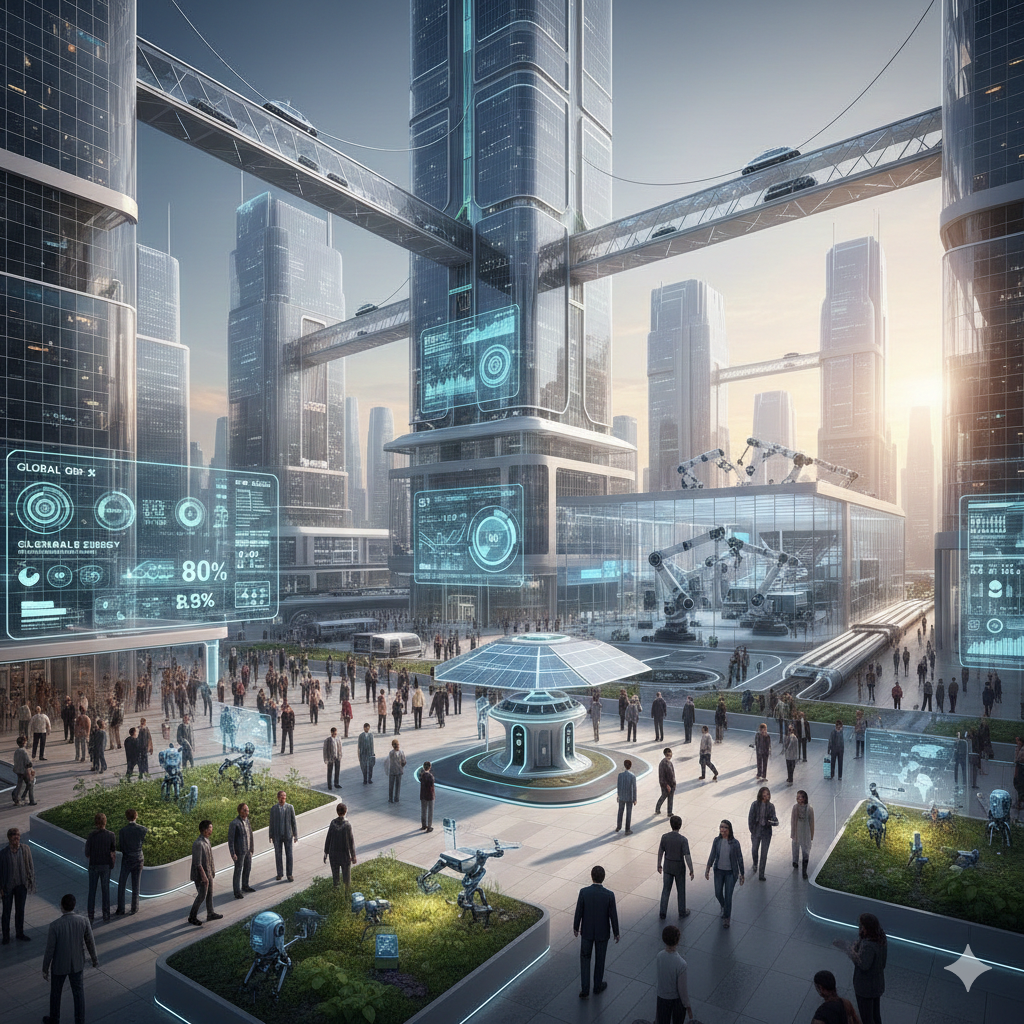
The Destination – The Global Economy in 2035
The Post-Labor Equilibrium and The Resource-Constrained Growth Model
By the close of 2035, the global economy has undergone a structural metamorphosis comparable in magnitude to the Second Industrial Revolution. The fears of secular stagnation prevalent in the 2020s, driven by shrinking workforces in the West and East Asia, have largely abated, replaced by a new set of challenges surrounding resource distribution and capital taxation. The "Great Divergence" did not result in the economic collapse of the aging bloc; rather, it catalyzed their transition into the Automated Care Economy. Conversely, the "Great Convergence" of the Global South was not driven by the export of cheap labor, but by the leveraging of Resource Sovereignty and Digital Integration.
The defining macroeconomic characteristic of 2035 is the decoupling of economic output from human labor hours in the physical domain. The "physical labor gap" that threatened to paralyze G7 economies in 2025 has been effectively closed by the deployment of over 150 million humanoid robots across industrial, logistical, and care settings. This automation wave has fundamentally altered the capital-labor share of income, necessitating radical shifts in fiscal policy to maintain consumption levels.
The Geopolitical Axis: The Shift to Asia and the Global South
The center of economic gravity has shifted irrevocably eastward and southward. By 2035, India has surpassed Japan and Germany to become the world's third-largest economy, driven by its massive internal market and a rapidly digitizing service sector. China, having navigated its demographic peak, has stabilized into a consumption-led model heavily reliant on the Silver Economy, which now accounts for a staggering 10% of its GDP.
The United States maintains its dominance in intellectual property and high-end compute, but its industrial base has been radically transformed. The reshoring efforts of the 2020s have succeeded, not by bringing jobs back, but by bringing production back, staffed by automated systems that render labor arbitrage obsolete. The European Union, facing the most severe demographic headwinds, has become the global regulatory superpower for the automated age, setting the standards for human-robot interaction and AI safety that the rest of the world follows.
The Automated Care Economy: A Day in 2035
The most visible transformation is in the Silver Economy, now a distinct economic engine worth over $30 trillion globally.7 The "old-age dependency ratio," once feared as a harbinger of fiscal doom 1, has been managed through the widespread integration of "Care-Bots." In Japan, Western Europe, and increasingly China, nursing homes and elder care facilities operate on a 1:5 ratio of human supervisors to humanoid assistants. These androids, sophisticated evolutions of the 2025 prototypes like Tesla's Optimus and Figure 03 , perform 90% of the physical drudgery: lifting patients, delivering medication, and maintaining hygiene standards.
This technological intervention has capped the inflationary spiral of healthcare costs that threatened to bankrupt OECD nations in the late 2020s. While spending by the over-75 cohort has surged—consumption in this demographic has grown by over 80% since 2025 —it is directed toward quality of life, preventative biotech, and experience, rather than basic subsistence care, which has been commoditized by robotics. The "Silver Yen" and "Silver Euro" have become powerful forces, driving innovation in pharmaceuticals, accessibility technology, and automated transport.
The African Green Industrial Hub
Sub-Saharan Africa’s trajectory has diverged sharply from the "Factory of the World" model pursued by China in the 20th century. With humanoid robots making textile and assembly manufacturing in Europe and the US cheaper than importing from low-wage jurisdictions, Africa avoided the "premature de-industrialization" trap by pivoting to Green Industrialization.
By 2035, nations like Kenya, Nigeria, and South Africa have leveraged their renewable energy assets to become the Green Energy & Data Hubs of the world. Realizing that the BPO route was blocked by AI automation , these nations focused on the one asset AI cannot generate: clean, baseload power. Kenya, utilizing its vast geothermal potential , hosts massive AI training data centers that require continuous green power—a resource that is scarce and expensive in the re-industrializing West.
The African workforce has evolved from the "Digital Sweatshops" of the mid-2020s. The commoditization of simple data labeling by synthetic data forced a move up the value chain. The 2035 African digital worker is a specialist in Human-in-the-Loop (HITL) Verification for high-stakes AI applications in medicine and law, and a manager of the physical infrastructure of the green grid. Intra-African trade, facilitated by the mature African Continental Free Trade Area (AfCFTA), has risen to 35% of total trade, insulated from global shocks by a robust regional payment system.
The Copper Standard and Resource Sovereignty
The defining geopolitical struggle of the decade was not over oil, nor data, but over Copper. By 2035, the "Copper Deficit" predicted in the 2020s has forced a radical restructuring of the global mining and energy sectors. A high-tech, AI-driven economy is intensely copper-intensive, requiring massive amounts of the metal for data centers, grid upgrades, and electric vehicles.
The "Scramble for Africa 2.0" has resulted in the US and EU signing binding Critical Mineral Defense Pacts with the DRC and Zambia. These agreements guarantee infrastructure investment and technology transfer in exchange for secure offtake agreements, effectively sidelining the spot markets and creating a bifurcated global mineral trade. "Urban Mining"—the recycling of electronics and old infrastructure—now provides 40% of the global copper supply, a necessity born of the physical limits of extraction.
(2032–2035) – Stabilization and The Post-Labor Contract
The Era of Integration and Standardization
By 2032, the extreme economic volatility that characterized the turn of the decade began to subside. The "productivity paradox"—where AI promised immense growth but initially delivered disruption and displacement—was finally resolved. The integration of Embodied AI into the physical economy reached maturity, and new social contracts began to stabilize the political landscape.
The Ubiquity of the Humanoid Workforce
In 2032, the unit cost of a general-purpose humanoid robot dropped below $20,000, achieving cost parity with the annual minimum wage in almost all OECD countries.4 This price point triggered a phase shift in deployment. Robots moved beyond the "walled gardens" of automotive factories and high-end logistics centers into unstructured, everyday environments: retail stocking, hospital logistics, construction site cleanup, and domestic assistance.
Analysis derived from robotics cost trends and labor market projections.
This diffusion was facilitated by the maturation of the "Cobot" Regulatory Model. Frameworks such as the EU Machinery Regulation, fully effective since 2027, standardized safety protocols, allowing robots to work unfenced alongside humans. This regulatory clarity was crucial in assuaging labor unions; robots were legally classified as "tools" requiring human oversight, preserving a layer of human employment in a supervisory capacity.
The economic implications were deflationary for goods and services. For the Silver Economy, this meant that the service component of inflation collapsed. Retirees on fixed incomes found their purchasing power preserved as the cost of automated services fell, allowing for a higher quality of life despite the demographic pressures.
The New Social Contract: Taxing Capital
The stabilization of 2032-2035 was underpinned by a radical shift in fiscal policy. The displacement of human labor by capital assets (robots and AI) eroded the traditional income tax base. In response, G7 nations, led by the EU and South Korea, implemented the Value Added Automation Levy (VAAL). This was not a tax on the hardware itself, but on the displacement value generated by the automated systems.
The revenue generated from these levies was hypothecated directly into the Universal Basic Dividend (UBD), a sophisticated evolution of the Universal Basic Income pilots conducted in the 2020s. Unlike the crude cash transfers of the past, the UBD was tied to the productivity of the national AI fleet, creating a direct link between automation success and citizen welfare. This policy innovation was essential to maintain aggregate demand in an economy where labor income was falling as a share of GDP.
The Maturation of the AfCFTA and the Digital Settlement
By 2034, the African Continental Free Trade Area (AfCFTA) had successfully moved past its "Phase II" protocols on digital trade and competition policy. Intra-African trade, which stood at a paltry 16% in 2025, rose to 35%. This growth was driven by the removal of non-tariff barriers and the completion of key transnational infrastructure corridors, such as the Lobito Corridor.
While the dream of a single physical currency for the East African Community (EAC) remained elusive, delayed past its 2031 target 31, a functional equivalent emerged in the digital realm. The Pan-African Payment and Settlement System (PAPSS), underpinned by central bank digital currencies (CBDCs), became the de facto unified currency for trade. This reduced the region's reliance on the US Dollar for cross-border settlement, insulating the African economies from Federal Reserve rate shocks and facilitating the seamless flow of goods and services.
Synthetic Data and the Verification Economy
By 2033, the debate over "AI Scaling Laws" that dominated the mid-2020s 34 had been settled. The "data wall"—the exhaustion of high-quality human text for training—was breached using high-fidelity Synthetic Data. This technological breakthrough decimated the lower tier of the data labeling market in the Global South. The "Digital Sweatshops" in Kenya and the Philippines, which had thrived on basic image bounding and text annotation, saw a collapse in demand.
However, this collapse catalyzed a shift to higher value work. The new economy required Semantic Verification—checking the logic and safety of AI outputs, a task that synthetic data could not reliably perform without risking "model collapse". This transition raised the skill floor for digital workers, increasing wages for those who could adapt but reducing the total headcount of the sector.
(2029–2031) – The Great Dislocation and The Resource Crunch
The Convergence of Debt, Scarcity, and Displacement
The period from 2029 to 2031 represented the most perilous phase of the transition. The "Hype Cycle" of AI collided violently with the "Physics Cycle" of energy and materials. Simultaneously, the debt loads accumulated by governments during the 2020s became unsustainable as interest rates remained structurally higher due to persistent "Greenflation."
The Global Debt Crisis and The Fiscal Stability Accord
The warnings issued by the IMF in 2025 regarding G7 debt-to-GDP ratios crossing the 100% threshold proved prescient. By 2029, global debt had exceeded $100 trillion, and the cost of servicing this debt consumed over 20% of government revenues in the US and Europe. The trigger for the crisis was a failed bond auction in a major G7 economy—likely the UK or Italy—in late 2028, which sent yields spiking and threatened a systemic sovereign default.
Faced with the choice between crushing austerity (political suicide) and financial repression, global policymakers chose the latter. The Fiscal Stability Accord of 2030, a coordinated G20 action, effectively monetized a significant portion of sovereign debt. Central banks accepted a period of elevated inflation (4-5%) to erode the real value of the debt burden. This inflationary period was only socially palatable because the concurrent AI-driven deflation in the price of goods and automated services softened the blow for consumers.
The "Copper Wall" and The AI Throttling
Between 2029 and 2031, the gap between copper supply and demand hit its absolute peak. The IEA's 2025 warning of a 30% supply shortfall materialized with devastating effect. The price of copper quadrupled, stalling the rollout of electric vehicles and, crucially, data centers.
Major hyperscalers (Google, Microsoft, Amazon) were forced to delay data center build-outs not due to a shortage of chips, but because they could not secure the grid connections and transformers—hardware that is heavily dependent on copper. For a period of 18 months, global AI compute growth plateaued. This "AI Winter of 2030" was supply-side driven, a stark reminder of the physical constraints on digital growth.
This resource crunch triggered a geopolitical "Scramble for Africa 2.0." The US and China engaged in fierce diplomatic and covert contests for mining rights in the Copperbelt (Zambia and DRC). The Lobito Corridor rail project, essential for exporting minerals to the Atlantic, became the most heavily guarded infrastructure project on earth, securing the flow of materials essential for the Western hemisphere's re-industrialization.
The White-Collar Recession and The Wage Inversion
As Generative AI tools became fully integrated into enterprise software suites (SAP, Oracle, Microsoft 365) by 2029, the displacement of white-collar labor accelerated rapidly. Entry-level analysis, coding, and administrative roles were decimated, leading to a "White Collar Recession." Unemployment among recent university graduates (aged 22-28) in the OECD hit 15%.
Conversely, the shortage of skilled tradespeople—electricians, plumbers, and robot maintenance technicians—drove their wages to historical highs. The "wage inequality" inverted in specific sectors, with blue-collar professionals outearning their white-collar counterparts. This period saw significant social unrest, the rise of "Neo-Luddite" movements, and the passage of "Right to Human Service" legislation in the EU, which mandated human interaction in sensitive sectors such as medical diagnosis and judicial rulings.
The Energy Pivot: SMRs Come Online
Desperate for power to feed the AI infrastructure without triggering crippling climate penalties, the tech sector accelerated the deployment of nuclear energy. The first commercial Small Modular Reactors (SMRs) came online in 2030, slightly ahead of the more pessimistic schedules. These units were initially deployed not for the general grid, but as "behind-the-meter" installations at massive data center campuses. This critical development effectively decoupled AI growth from the fragile and congested national grids, allowing compute scaling to resume its exponential trajectory by 2032.
(2025–2028) – The Acceleration and The "Gap Years"
The Present Bottlenecks and Strategic Positioning
This initial phase is defined by the "scaling" of pilots to production, the friction of early adoption, and the strategic positioning of nations for the changes to come.
The Energy Crisis of the Data Center (2025–2027)
In 2025, the AI industry collectively realized that "compute" was no longer the primary bottleneck—electricity was. Power demand from data centers in the US was projected to triple by 2030 , creating a crisis of capacity. In 2026, utilities in key hubs like Virginia and Ireland began issuing moratoriums on new data center connections, threatening to strangle the AI boom in its cradle.
This crisis created a unique opportunity for nations with surplus green power. Kenya, with its grid powered 90% by renewables (Geothermal and Hydro), aggressively pitched itself as a sustainable AI training hub. The "Code Nation" plan successfully attracted hyperscalers to Nairobi, drawn not just by the labor force, but by the availability of green joules essential for meeting corporate net-zero commitments.
The Pilot Phase of Embodied AI (2025–2026)
This period marked the transition of humanoids from "YouTube demos" to legitimate industrial pilots. By late 2025, companies like Agility Robotics (with their 'Digit' robot) and Tesla (with 'Optimus') were logging millions of hours in live logistics environments.
2 million unfilled manufacturing jobs in the US.
Created urgent demand for automation in logistics and assembly.Cost Curve
Unit costs falling from $100k+ to ~$85k.
Enabled ROI positive pilots in high-wage regions (USA, Germany).
AI Integration
Integration of Vision-Language-Action (VLA) models. Allowed robots to understand natural language instructions and navigate unstructured spaces.
First movers in the logistics (Amazon, DHL) and automotive (BMW, Hyundai) sectors began to deploy these units to fill the chronic labor voids that migration alone could not address.
Kenya's Digital Dilemma: Silicon Savannah vs. Sweatshop
Kenya's economy in this period exemplified the tension of the new age. On the high end, the "Silicon Savannah" flourished. Fintech innovation, building on the M-Pesa legacy, and Agri-tech startups attracted significant venture capital. The introduction of the Digital Nomad Visa brought thousands of tech workers to the country, boosting local consumption but also driving up housing costs in Nairobi.
However, the "Digital Sweatshop" reality persisted. Thousands of young Kenyans were employed for less than $2 per hour annotating data for US AI firms. While criticized as exploitative, these jobs provided a vital source of foreign exchange and employment during the country's difficult debt restructuring negotiations with the IMF. The government successfully navigated this period by using "Debt-for-Nature" swaps, leveraging its carbon sinks to manage Eurobond maturities.
The Silver Economy Awakening
By 2027, the consumer market began to recognize that the Silver Economy was the only consistent growth demographic in the G7. Multinational corporations pivoted their marketing strategies entirely toward the "New Mature Group". "Longevity Finance" emerged as a major asset class, with banks creating financial products designed for 100-year lifespans. The market capitalization of the Silver Economy crossed $20 trillion, cementing its status as a pillar of global demand.
Sector Deep Dives and Theoretical Integration
1. The Humanoid Robotics Cost-Labor Curve
The defining economic equation of the decade is the cross-over point where the Hourly OpEx of a Robot falls below the Hourly Wage of a Human. This intersection drives the substitution effect. The precipitous drop in robot costs is driven by the "EV Effect"—the commoditization of batteries, actuators, and sensors, which are shared supply chain components with Electric Vehicles. China's dominance in this supply chain gives it a strategic advantage in the robotics race, allowing it to flood the market with affordable units much faster than Western competitors.
2. Africa’s Economic Pivot: Beyond the Factory
The "Great Demographic Divergence" report likely predicted Africa would follow the Asian Tigers model: Export-led manufacturing -> Service Economy -> Knowledge Economy. AI breaks the first two rungs of this ladder.
- The Manufacturing Rung: Robots make cheap labor irrelevant. A shirt sewn by a robot in North Carolina is cheaper (after shipping/tariffs) than one sewn by a human in Ethiopia, even if the Ethiopian wage is $1/day.
- The Service Rung: Call centers and BPO are being obliterated by GenAI agents.
The African Pivot (2025–2035) requires leapfrogging to Rungs 4 & 5:
Green Industrialization: Processing minerals in-country using green power (e.g., refining Lithium in Zimbabwe, not just exporting ore).
Food Systems: Deploying Vertical Farming and precision agriculture to feed the 2.5 billion population, reducing the $50B+ food import bill.
Human-Centric Services: Exporting culture and care, leveraging the human element that AI cannot replicate.
3. The Debt & Demographics Ouroboros
The G7 nations are trapped in a cycle where aging increases costs , a shrinking workforce reduces revenue, and high debt increases interest payments. The 2035 solution is the Taxation of Capital over Labor. The shift to a "Value Added Automation Levy" is inevitable to fund the social safety nets required in a post-labor economy. This represents the most significant change in fiscal philosophy since the introduction of the income tax.
My Take
The decade from 2025 to 2035 will not be defined by a simple divergence between the "Old North" and "Young South." It will be defined by the collision of Biology and Silicon. The "Great Demographic Divergence" report was correct in its diagnosis of the problem (aging vs. youth) but incomplete in its prognosis. It failed to see that AI and Robotics are the equalizers. They allow aging nations to remain productive without workers, and they force young nations to find new value propositions beyond labor.
The world of 2035 is one where the "Dependency Ratio" is no longer calculated by (Retirees / Workers) but by (Retirees / (Workers + Robots)). The nations that grasp this formula first—integrating the mechanical workforce while securing the energy to power it—will dominate the mid-21st century. Those that rely solely on the demographics of the past will find themselves servicing debt they cannot pay, for a future that never arrived.
Scribe's Mark of Tomorrow
🏺Mr. Derrick Macharia
*Keeper of Emerging Wisdom*
AI Engineer @Pawanax
📜Share What's Next📜
Related Future Scrolls
📚*Discover more wisdom from the Royal Library's collection*

Still not a recession, Yet!
" Hello again, family. If Friday’s market felt like a sudden, violent plunge in a faulty elevator, I want you to know you're not wrong. The alarms wailed, the floor dropped out, and the G-force of the sell-off pinned us all to the wall. The immediate, hum..."
Mr. Derrick Macharia

Is this the Recession ?
" Friday's Bloodbath: What Just Happened, and How to Navigate the Coming Storm Good morning, family. Let's not sugarcoat it. Friday was a massacre. The kind of day where you open your portfolio, and it looks like a scene from a slasher film. Red, everywh..."
Mr. Derrick Macharia

Pawanax AI & Consumer Habits: Why Africa’s Multimodal Medical AI Is Poised to Win
"Pawanax AI & Consumer Habits: Why Africa’s Multimodal Medical AI Is Poised to Win Pawanax AI — a multilingual, multimodal medical AI that bundles a Doctors’ Assistant and a Personal AI Doctor — is uniquely aligned with how people actually use AI today. B..."
Mr. Derrick Macharia
Join the Circle of Tomorrow
"Receive future-focused healing insights as the Muses whisper what’s next to your chamber."
Join the sacred circle of healers • Unsubscribe with a whisper to the wind